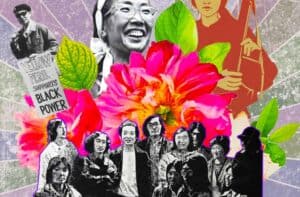
Source: Negra Bohemian
Celebrating AAPI Heritage Month: 5 AAPI Women who have made history
You can read the original blog post on medium, here.
May 2021 – May is Asian American and Pacific Islander (AAPI) Heritage Month, and it’s important to remember and honor the contributions and influence of members of AAPI communities today and throughout history. This month, we want to celebrate AAPI women who have made, and are currently making history as trailblazers, leaders, storytellers, and artists, both nationally and around the world!
Over the last year, the deadly implications of racism and hatred towards Asian Americans have been on the rise as a direct result of harmful rhetoric surrounding the COVID-19 pandemic, but also throughout the history of anti-Asian discrimination in the United States. It’s essential to share stories and uplift voices of the AAPI community to #StopAsianHate and dismantle white supremacy.
That’s why today, we are highlighting 5 Asian American and Pacific Islander women who have made history and changed the world!
Grace Lee Boggs
“It is a time of deep change, not just of social structure and economy but also of ourselves. If we want to see change in our lives, we have to change things ourselves.”
Grace Lee Boggs, born June 27, 1915, was an American author, social activist, philosopher, and feminist. A daughter of Chinese immigrants, Boggs received her B.A. from Barnard College (1935) and her Ph.D. in Philosophy from Bryn Mawr College (1940). After graduate school, she moved to Chicago and struggled to find work, which she later attributed in part to racism against “Orientals.” It was in Chicago where she began her activism with the Black community, and saw firsthand the racism she once only understood as “statistics.” During the Civil Rights Movement in the 1960s, she became one of the city’s most noted activists, promoting issues that included environmentalism, feminism, Black Power, and labor and civil rights. She went on to spend her entire life committed to promoting the values of equity and justice. She also helped create the Boggs Center, an organization committed to helping activists develop into leaders and critical thinkers. Boggs died in 2015 at the age of 100.
Kalpana Chawla
“The path from dreams to success does exist. May you have the vision to find it, the courage to get on to it, and the perseverance to follow it.”
Kalpana Chawla was the first Indian-born woman in space. Born in Karnal, India, on July 1, 1961, Chawla obtained a degree in aeronautical engineering from Punjab Engineering College before immigrating to the United States and becoming a naturalized citizen in the 1980s. She began working at NASA in 1988 and was eventually chosen to be part of the Space Shuttle Columbia team, which flew to space in 1997, as a robotic specialist. However, in 2003, the Space Shuttle Columbia spacecraft unfortunately crashed during its return to Earth. Chawla was one of the crew members who died in the accident.
Patsy Mink
“We have to build things that we want to see accomplished, in life and in our country, based on our own personal experiences … to make sure that others … do not have to suffer the same discrimination.”
Patsy Matsu Takemoto was born on December 6, 1927, in Paia, Hawaii. In 1964, she became the first woman of color elected to the U.S. House of Representatives and the first Asian American woman to serve in Congress. Later, she was the first Asian American to run for U.S. President. She was a key contributor in writing and advocating for Title IX, a law that advanced gender equity within federal funding policies for education. This law was later renamed the Patsy T. Mink Equal Opportunity in Education Act in her honor.
During her time in Congress, she also introduced the first comprehensive Early Childhood Education Act. She was a strong environmental advocate, and after her career in Congress, Mink was appointed by President Carter as Assistant Secretary of State for Oceans and International Environmental and Scientific Affairs in 1976.
Yuri Kochiyama
“Life is not what you alone make it. Life is the input of everyone who touched your life and every experience that entered it. We are all part of one another.”
Born in 1921 as Mary Yuriko Nakahara, Yuri Kochiyama spent the early years of her life in San Pedro, California, a small town south of Los Angeles. After the Japanese attack on Pearl Harbor, she and her family were forced to relocate to internment camps along with tens of thousands of other Japanese Americans. She later relocated to New York, where living in housing projects among Black and Puerto Rican neighbors inspired her interest in the Civil Rights Movement.
In 1963, she met Malcolm X whom she became good friends with, radicalizing her activism. Kochiyama began focusing her work on Black nationalism and was with Malcolm X during his final moments. In the 1980’s, she pushed for reparations and a formal government apology for Japanese American internees through the Civil Liberties Act, which President Ronald Reagan signed into law in 1988
She spent her entire life dedicated to the pursuit of social justice, not only for the AAPI community, but for all communities of color.
Junko Tabei
“Technique and ability alone do not get you to the top; it is the willpower that is the most important. This willpower you cannot buy with money or be given by others… it rises from your heart.”
Junko Tabei was born in 1939 in a small town in Fukushima, Japan. During a school trip to Mount Asahi in the mountain range, she discovered the pleasures of mountains and nature. She went on to become the first woman to reach the summit of Mount Everest and the first woman to ascend the Seven Summits, climbing the highest peak on every continent.
Tabei was also an author, environmentalist, and activist who defied barriers by climbing when mountaineering clubs in Japan were prohibited for women. She founded the Ladies Climbing Club in 1969, continuing to pave the way and opening opportunities for Japanese women.
Here’s to honoring inspirational and monumental women during Asian American and Pacific Islander Heritage Month! To continue supporting the AAPI community and to #StopAsianHate, below are a number of resources to help you educate yourself, speak up, talk to children, and fight anti-Asian racism and white supremacy.
RESOURCES:
In Solidarity with the Asian American Community
Anti-Asian Violence Resources (includes mental health resources, learning information, petitions, donations, statistics, and more)